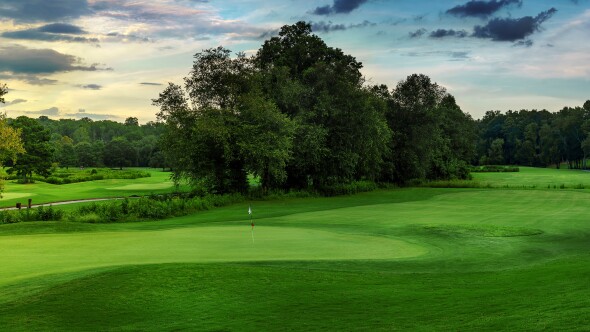
CHARLOTTETOWN, Prince Edward Island - Curiosity has brought me more satisfaction than trouble, so I usually indulge it. A question nagging me was how Lorie Kane, a young woman from a small island off Eastern Canada, rose to prominence on the LPGA Tour. Could it be the courses she played at home?
Determined to find out, a friend and I caught a plane to Charlottetown, the capital of Prince Edward Island, Canada's smallest province. The island was only accessible by air or boat until the late 1990s, when an eight-mile-long bridge connected it to the New Brunswick mainland.
We soon discovered that the pace on P.E.I. is attuned to the island'sthree major industries - fishing, farming and tourism. You don't rushany of these. For about six months of the year the leisurely lifestyleand pastoral setting draw 1.2 million visitors, many from the northeastU.S. Some have been coming here for generations to stay at colorful innsand bed-and-breakfasts near the beaches and to play the seaside courses.
We had our choice of more than 25 layouts, including one that Golf Digest once listed in North America's top 10, a couple in Canada's top 10, and of course, Kane's home venue. ScoreGolf Magazine has named it the top golf destination in Canada.
There's a lot of quality golf concentrated on an island twice as bigas Rhode Island but with fewer residents (134,000) than the city ofProvidence. By week's end we found that tee times are easy to arrange,and greens fees are a steal ($55 or less). Lodging is equallyinexpensive, and dining (on great local seafood and produce) is quitereasonable.
Over breakfast in Charlottetown's Fairholm National Historic Inn (arestored mansion near the harbor and a plethora of fine seafoodrestaurants) I asked the waitress if she had read Anne of GreenGables, written by the late Islander L.M. Montgomery. She blushed,and admitted she had not.
Locals apparently don't share the rest of the world's continuing fascination with the 1900s children's classic that put P.E.I. on the map. The book is a favorite of Japanese youngsters, and thousands of their families make the pilgrimage to P.E.I. and Green Gables every year. In Japan, American builders do a brisk business constructing Green Gables-style houses.
Curiosity struck again. We briefly joined the international throngfiling through the reconstructed farmhouse and barn at Green Gables inPrince Edward Island National Park. But we were more interested in whatlay beyond the farm's garden gate - the 11th hole of Green Gables GolfCourse, one of six courses we had decided to play.
Green Gables Golf Course, a 6,459-yard, par-72 Stanley Thompsondesign built in 1939 and revamped in the 1980s, is a relatively opentrack bordered by mature hardwoods. The course is touted as a long-timearea favorite, but this must be due to its association with the historicfarm and proximity to the stunning sand dunes of the national park. Itcan't measure up to the newer venues, but Green Gables has somememorable holes are on the back nine, where the Lake of Shining Waterscomes into play. The signature 16th hole is a lovely 181-yard par 3that crosses a corner of the lake.
Not far from Green Gables is Eagles Glenn Golf Course, which has been creating a stir since the opening of its first 18 holes in 2002. On 300 acres of pretty countryside, architect Graham Cooke plotted a masterful 18-hole track spiced with four large irrigation ponds, artful mounding, and nearly 80 white sand bunkers. There are 10 par 4s, four par 5s and four par 3s in the layout. Cooke sweetened the pot with a nine-hole, par-27 course and state-of-the-art practice facility.
We stopped off at one of the many village halls offering a feast of fresh local lobster, then spent a balmy evening at the Charlottetown Driving Park, a harness track near the center of town. Horse racing here is a family affair, with grandfathers and teenagers competing in spindly-wheeled sulkies while town folk cheer from the grandstand.
The next morning, a 25-minute drive took us past bucolic farms withbuildings painted in bold Caribbean hues, and equally colorful fishingvillages mirrored in quiet harbors. All commercial signs are small,uniform, and black-and-white, so the view is unsullied.
On the windswept north coast we found what we'd been looking for - a course that would stick in our memories. In 1998, when the Links at Crowbush Cove was named one of Golf Digest's top 10 places to play in North America, the provincial government capitalized on the attention and began upgrading government-owned courses and encouraging private development of new ones. As a result, the island's standing as a golf destination soared.
Crowbush, a 1994 Thomas McBroom creation playing 6,901 yards from theback tees, has competition on the island, but it is still one of a kind.It looks as if it were scooped from the British Isles and set down onthe island. Eight holes skirt spectacular sand dunes and eight holesinvolve water, usually in the form of salty marshes. Fairways borderedin tall brown grasses pitch and roll like frozen green waves, theirsurfaces pocked with deep, heavy-lipped pot bunkers.
As we stood on the back tee of the par-3 sixth hole, trees protectedus from the wind off the ocean, but we could see the flag whipping onthe narrow green 191 yards away. Marshland in front of the tee drainsinto a lake left of the green. Bunkers guard the right and rear. Aiming20 yards to the right worked for us the first round, but the wind wasentirely different the next day.
The back tee of the 11th hole is perched high on a dune, providing apretty view of the 18th hole as well as the immediate danger ahead. Thesecond shot on this par 5 calls for a water carry, followed by anapproach shot over deep bunkers or through a narrow run-up.
After playing we fortified ourselves with big buckets of steamedmussels, an island specialty, in the pretty colonial-style clubhouse.
The course that rivals Crowbush for beauty and toughness isDundarave. This Michael Hurdzan-Dana Fry track lies next to thevenerable Brudenell River Course in the Brudenell Golf Resort.
Like Crowbush, Dundarave is a wild, natural beauty, with knee-deep brown grasses and deep ravines. However, it has an unmatched feeling of isolation as it winds through deep woods along the river. Another natural touch is the indigenous reddish sand used in the bunkers.
Despite its beauty, Dundarave is perhaps too severe for the averagegolfer the resort draws. Landing areas are usually generous, but goodstrokes may be punished unduly by a minefield of deep bunkers on everyhole. The route stretches 7,284 yards from the back tees, with otheroptions being 6,823, 6,252, 5,607 or 4,997 yards.
The toughest par 3 is the 237-yard seventh hole, which has a stingygreen ringed with deep bunkers in the middle of a windswept field ofgrass. The daunting eighth hole is a par 4 that crosses a deep gully,then doglegs to a tiny, fast green on the river's edge. The finishinghole is a 542-yard par 5 with a dozen well-placed bunkers. It's called"Victory Chimes," but Coup de Grace might be more appropriate.
The Brudenell River Course, a traditional layout with level fairwaysand moderate bunkers, is a sharp contrast to Dundarave, but far from apushover with its dense rough and susceptibility to wind. A longtimestop on the Canadian Tour, the 6,591-yard course hugs the river and issusceptible to wind. Swirling gusts are the norm on the 163-yard fifthhole, called "Ink Pot," and the 10th hole, "Shimmering Waters," a143-yard beauty with water on the front and left.
Not far from where we'd enjoyed our lobster feast in New Glasgow is anew golf resort just five minutes from Cavendish, 20 minutes from Charlottetown and 30 minutes from the Confederation Bridge. GlasgowHills Resort & Golf Club sports a Les Furber design on a rolling pieceof land that, helped by elevated tee boxes, offers long panoramic viewson nearly every hole. Ranging from 6,915 to 5,279 yards, the coursemakes good strategic use of five ponds. The 17th hole, a 502-yard par 5ranked third hardest, begins with a very elevated tee, climbs uphill onthe second shot and presents a blind approach to a very elevated andshallow green. Another nine holes are in the works for this invitinggolf resort.
Our P.E.I. golf sampler included a 30-year-old favorite of the Charlottetown crowd. The Stanhope Golf Club zigzags 6,600 yards across a hillside overlooking scenic Covehead Bay. Wind off the water constantly buffets its unassuming, open fairways. Every approach shot and most putts are memorable, because the undulating cloverleaf greens are usually set in bowls created by high mounds.
We also played the Fox Meadow Golf and Country Club nearCharlottetown, a Rob Heaslip creation stretching 6,836 yards, thatopened in 2000. The course was very open when it was new, but the roughof clover and crown vetch have matured into gorse-like toughness. Manyof the greens are crowned and shed balls like water. Swirling winds area constant factor, and tend to kill those uphill approach shots.
People of Scottish descent make up the largest ethnic group on P.E.I., and it takes little curiosity to discover evidence of these roots. The island has an official dress tartan, a Piping College for aspiring bagpipers, town names such as Shamrock and New Glasgow - and a selection of golf courses that would make the forefathers proud.
Family-style "Lobster Suppers" are the ultimate diningexperience in P.E.I.. More than a dozen communities have them, and youcan count on fresh lobster, mussels, breads, soups and desserts - allfor one reasonable price.
Prince Edward Island's capital city, Charlottetown, is roughly 1,000miles from Toronto, 625 miles from Montréal, 650 miles from Boston and850 miles from New York City.
The Fairholm National Historic Inn (888-573-5022, fairholm.pe.ca) in Charlottetown is a restored 1839 mansion within walking distance of historic sites, the harbor, and several fine seafood restaurants.
The Rodd Brudenell River Resort (800-565-7633, rodd-hotels.ca) has motel-style rooms and cottages with easy access to the Brudenell and Dundarave courses.
The Inn at Spry Point (902-583-2400, innatsprypoint.com) is asmall, elegant hotel on an isolated spit of land within a half-hour'sdrive of the Dundarave, Brudenell and Crowbush courses.
It's hard to find a bad meal anywhere in P.E.I., even at the racetrack. The harbor in Charlottetown is lined with great seafood restaurants, and every village has cafes and restaurants frequented by locals. Look for the parking lot with the most cars.
New Glasgow Lobster Supper - It's been in operation for almost 50 years and is packed every night. We came away groaning from a meal that included a lobster fresh from the pound on premises, plus all-you-can-eat seafood chowder, cultivated mussels and desserts. www.peilobstersuppers.com
April 12, 2004
Dale Leatherman is a full-time freelance travel writer specializing in golf and adventure travel. For nearly 20 years her "beat" has been the Caribbean, where she can combine golf, scuba diving and other sports. She has also written about golf in Wales, Scotland, Australia, Costa Rica, Canada and the U.S., particularly the Mid-Atlantic region.
While the masses come to Banff Springs from all over the world, Kananaskis is lesser known. But it's closer to Calgary, and peak-season green fees for Kananaskis Country Golf Course are a bit cheaper than Banff Springs, Stewart Creek and Silvertip as well (and there's no charge for grizzly bear sightings).
... full article »